

There is something about long-haul travel conducted in solitude that infuses the mind with a strange kind of focus. As I returned to Kiev for the first time, having left that place as a boy of three, and now a man of 33, my mind returned again and again in abstract and discordant ways to family.
Over the years whenever my thoughts have turned to Kiev, I could visualise nothing more than a grey blur, like a ragged woollen jumper. The only image that retains any clarity is one that my mind has created. I can picture my family, the family with which I left Kiev, forever preserved in our ages at the time of our departure, standing stoically in our winter clothes.
I also associate Kiev with fear. Fear is the dominant sentiment that inhabits the stories of my parents and grandparents. The fear that my family felt when they were denounced as traitors and expelled from their professions for applying to leave the Soviet Union so that my brother and I could live in dignity in the West. The fear they felt when grim, sneering bureaucrats flicked through their identity papers and their eyes settled on that notorious fifth paragraph that revealed their nationalities to be Jewish. And the fear that my mother felt during her daily commute from work as the trolley-bus crept towards that sacred, cursed place where in September 1941 the Jews of Kiev, then under Nazi occupation, were made to huddle naked on the edge of the ravine and wait for their turn to die. She would tell me how every single day, just as the conductor would call “Next stop, Babi Yar” (the name of that ravine), at least one passenger would cry out and cackle and lament, “If only they had shot all the Jews here!”
As Doctor Zhivago flitted on my screen and the plane’s flight path showed us to be between the chaotic skies over Syria and eastern Ukraine, I thought about that ravine, just a block from where my family had lived, where I played as a child and would soon be stepping once again over the thousands upon thousands interred.
Kiev was not at all like I had expected. In truth, I no longer recall what I expected, the real immediately displacing the imagined.
I suspiciously eyed the locals, scanning the faces in search of my family’s tormentors and of those, motivated by larceny, hatred or indifference, who played their part in putting my people into the ravine. My eyes fell on an elegant young woman with ice-blonde hair in braids. Then a stout, grizzled fellow with a prominent brow, resembling an Olympic weightlifter, and an ageing bohemian with flowing hair and an unruly goatee, who looked like Chekhov. All perfectly agreeable in their own ways.
Finally I fixed my gaze on a thick-necked vulgarian, cheeks sagging, giving the impression of permanent outrage, small, darting eyes and a nose red from drink. I told myself that I had successfully profiled a petty bureaucrat or Nazi collaborator but then I sighted his Gucci loafers, designer jeans and Swiss watch and doubt crept in. Maybe capitalism does civilise.
While in transit, I had resolved to run my fist through the jaw of anyone who called me a “Yid” but it seemed that the place I returned to was not the one I left behind. At any rate, the current trajectory of Ukrainian nationalism is more concerned with the Russian peril than the Jewish one.
I stared incredulous at the Israeli flags adorning Kiev’s main boulevard in honour of the Israeli President’s visit and was bemused by the rolls of toilet paper with images of Vladimir Putin that took pride of place in souvenir stands across the city.
A cab driver laconically summed up the current attitude as being, “if there’s no water in the taps, the Russians must have drunk it all”, a new-age take on the old ditty that once blamed the “Yids” for all the ills of society.
Later, on the train back to the airport, I would overhear a local pontificating to his girlfriend about the arrogance with which “the Jews” conduct themselves. I recalled my mother’s torment before delivering some words that caused the man to withdraw and that are unfit for publication in any language. That incident, poignantly my last interaction with a local, assured me that sooner or later the cab driver’s new slogan would revert to its original form.
I rode the trolley-bus from the city centre to Babi Yar but alighted a few kilometres south of the ravine. There I was to commence my personal March of the Living, retracing the death march taken by Kiev’s Jews 75 years ago to the day.
On September 28, 1941 notices appeared throughout the city ordering the Jews to assemble at an entry point to Babi Yar by 8am the following morning with their “documents, money, valuables, warm clothes, underwear etc”, or face death.
Some chose to believe that deportation awaited them. Others simply obeyed. One witness described the wretched procession of “howling children, their old and sick, some of them weeping … with their bundles roughly tied together with string and worn-out cases made from plywood”. Others recalled seeing pure terror on the faces of the Jews as they drifted to their deaths under the gaze of their Ukrainian neighbours who had lined the street to watch.
I thought about the witness who recalled seeing a Jewish woman approaching the assembly point, turning to a soldier and asking in German: “What’s next?” “There is no next,” he replied.
I walked alongside the wall of the old cemetery and remembered the account of Dina Pronicheva, who survived the massacre by jumping into the ravine a moment before the firing began and sheltering under piles of bodies before making her escape at nightfall. She described the moment she leapt into the abyss as like jumping into a “bath full of blood”. She had observed German soldiers losing patience with Jewish mothers unable to control their screaming children, snatching the distraught babies away and tossing them over the wall of the cemetery “like a piece of wood”.
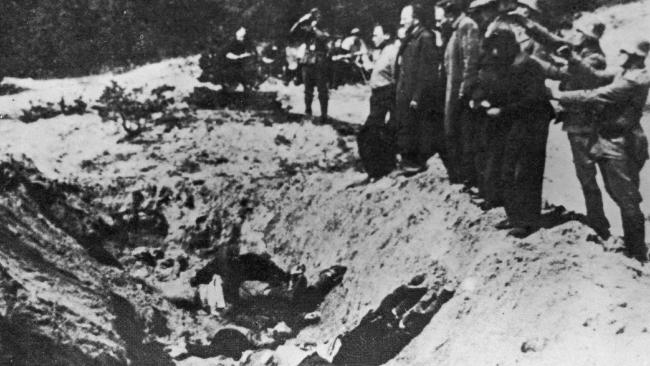
I now stood where the victims were forced to deposit their possessions, strip naked in the autumn chill, before proceeding to the edge of the ravine in small groups. The victims were then made to pass through a tight cordon of soldiers with dogs where they were clubbed mercilessly before reaching the other side. Pronicheva recalled the soldiers “laughing happily as if they were watching a circus act”.
Humiliated, wounded, bewildered, the victims teetered on the edge of the ravine, clutching their children and loved ones as they awaited the fire of machineguns and toppled into the void beneath them. Some were not lethally wounded and bled to death under a mass of bodies. Others slowly suffocated under the earth that was heaped on to the victims at the end of each day of killing. Residents heard the “ta-ta-ta, ta-ta …” of machinegun fire from dawn until nightfall and reported that the killing site shifted and groaned for days after the massacre.
I descended into what remains of the ravine and gazed out at what is now a pretty urban green space with its once harsh peaks and deep gullies levelled out into gentle slopes by the 150,000 corpses that lie underfoot. Couples stroll hand in hand, youngsters guffaw and sip beers on one of the slopes, all totally oblivious to the scale and depth of horror that once occurred there, and which has forever sanctified the ground upon which they unknowingly tread.
I left Kiev a few days later, having seen the house where I spent the first years of my life and visiting the Soviet-era cemetery further north where my relatives lie.
But the object of my visit had been Babi Yar. I had come there to, in some hopelessly futile way, honour those Jews, indistinguishable from myself in looks, language and thought, for whom the march to Babi Yar was a final march of death and not a symbolic march of the living.
I departed haunted by their memory and by the callous indifference to suffering all around me. I think of the words of the Russian poet Yevgeny Yevtushenko: “No fibre of my body will forget this.”
Alex Ryvchin, Public Affairs Director, Executive Council of Australian Jewry.
This article was published in The Australian, October 29, 2016.