
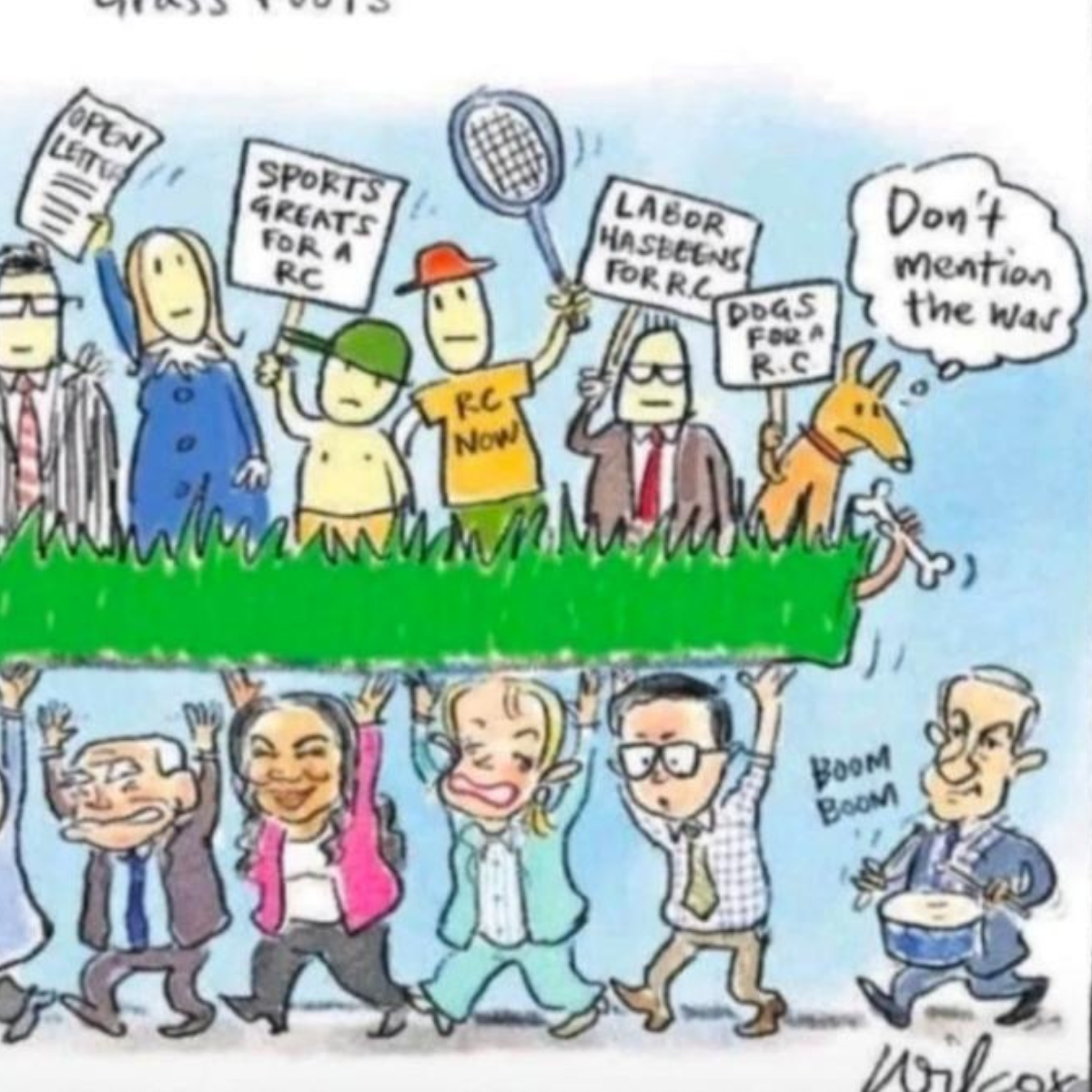
The Press Council considered whether its Standards of Practice were breached by the publication of a cartoon in The Age and The Sydney Morning Herald on 7 January 2026 captioned “Grass roots”. The cartoon depicts a crowd of figures above a strip of grass, holding placards and calling for a Royal Commission. The figures above represent various groups including lawyers, business people, sports identities, and Labor figures, with signs reading “Business People for RC”, “Lawyers for a Royal Com”, “Sports Greats for a RC”, “Labor Has Beens for RC” and “Dogs for a RC”. One figure has a thought bubble reading “Don’t mention the war.” In the background there is a figure carrying a megaphone agitating for a Royal Commission. In the foreground, are a number of identifiable political figures – David Littleproud, Sussan Ley, Jacinta Price, John Howard, Jillian Segal and Rupert Murdoch – who are carrying the grass above their heads as they march along. Separate from this group and to the far right, is a figure resembling the Prime Minister of Israel, Benjamin Netanyahu, beating a drum accompanied by the words “Boom Boom”.
In response to complaints received, the Council asked the publications to comment on whether the material breached its Standards of Practice which requires the publications to take reasonable steps to avoid causing or contributing materially to substantial offence, distress or prejudice, or a substantial risk to health or safety, unless doing so is sufficiently in the public interest (General Principle 6). The Council noted that the complaint raised concerns that the cartoon relies on imagery and themes that closely resemble well-established antisemitic tropes, portraying Jewish figures as manipulative actors exerting hidden influence beneath a supposed “grassroots” movement. The complaint also raised concerns the cartoon diminishes the legitimate concerns expressed by those who have been directly affected by the shooting as well as those from the broader community who have called for a Royal Commission into the shooting. In relation to this, the cartoon implies that their reasoning is not predicated on their concerns with the murders, but a willingness to be manipulated by “Zionists”, marching to Netanyahu’s drum.
In response, the publications said the cartoon should be considered in the context of the significant public debate following the terrorist attack at Bondi on 14 December 2025 and the subsequent widespread calls for a Royal Commission. The publications said the cartoon’s intention was to scrutinise the almost immediate politicisation of the genuine calls for a Royal Commission, which became a political attack against Prime Minister Anthony Albanese and to illustrate the phenomenon of “astroturfing” where privately funded or politically motivated campaigns are designed to resemble organic grassroots movements. It said the title “Grass roots” was used ironically for this purpose. The publications said the depiction of Benjamin Netanyahu was premised on his public comments in the hours after the attack, in which he condemned Prime Minister Albanese’s recognition of Palestine as having “poured fuel on the antisemitic fire.” They said the cartoon was not intended to invoke antisemitic tropes but rather to comment on the role of external and internal political actors in shaping the domestic debate. The publications acknowledged that while some readers found the cartoon thought provoking, many readers, particularly members of the Jewish community, were hurt and offended by the cartoon. They said that upon hearing the gravity of the community’s distress it took prompt action, publishing prominent apologies and a range of reader letters on the matter. It said senior editorial leaders had also scheduled a meeting with members of the Jewish community. Notwithstanding its apology, the publications said the cartoon was published in good faith on a matter of clear and significant public interest and at a time of significant public debate about a Royal Commission, and that the public interest in freedom of expression, including the freedom of cartoonists to comment on major news events, was sufficient to justify any offence caused.
Conclusion
The Council recognises that cartoons are expressions of opinion that often use exaggeration and absurdity to make a point on serious issues. For this reason, the Council has given significant latitude to cartoons when considering whether a publication has taken reasonable steps to avoid substantial offence, distress, or prejudice. However, that latitude is not unlimited, particularly where a cartoon can reinforce racial, ethnic or religious stereotypes.
The Council acknowledges the publications’ comments that the cartoon’s intention was to comment on the politicisation of the calls for a Royal Commission. The Council also acknowledges the publications’ comments that there was no intention to cause offence or prejudice. The Council notes that the intention of the cartoon or the message it is attempting to convey may be interpreted in different ways. In this context, the Council notes the depiction of political figures carrying the purported grassroots movement above their heads, while Netanyahu, who is both Jewish and the Israeli Prime Minister, stands apart, beating the drum to which the political figures march. The Council considers this imagery encodes the antisemitic trope that Jewish people secretly control or manipulate global events, governments, financial systems, or the media. The Council considers this imagery was likely to cause or contribute to substantial offence, distress and prejudice particularly to those who are Jewish.
While the Council recognises the public interest in commenting on the political motivation of some calling for the Royal Commission into the terrorist attack, the Council does not consider it was sufficient to justify the substantial offence, distress or prejudice caused or contributed to, in depicting those calling for a Royal Commission as being manipulated by the Israeli Prime Minister. Accordingly, the Council concludes that the publications failed to take reasonable steps to avoid causing or contributing materially to substantial offence, distress or prejudice in breach of General Principle 6.
The Council welcomes the publications’ published apologies and their stated intention to meet with Jewish community leaders.
The Council notes that, apart from finding that the publications failed to take reasonable steps to comply with its Standards of Practice, this matter underscores the importance for all publications of ensuring their editorial processes are sufficiently robust to minimise the unintended risk of causing offence, distress or prejudice. The Council also notes that, in the context of heightened community sensitivities concerning antisemitism and social cohesion, the adequacy of editorial processes should be assessed by reference to the sensitivity of the subject matter and the potential impact on affected communities.