

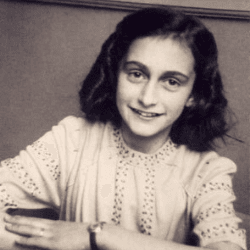
The following article has been published in J‑Wire and The Times of Israel Blogs by Julie Nathan.
The theatre production of The Diary of Anne Frank is playing in Newtown, Sydney. I saw it last month when it opened…writes Julie Nathan.
The play was powerful, moving, and sensitive. The acting was highly professional. The characters portrayed the situation, the fears, the pressures, and the closeness of the Jews hiding in the attic. It also showed the bravery and moral courage of the gentiles who put their own lives at risk to save Jews. The Newtown production brought this 71-year-old diary to life with great vibrancy. I would urge all those so inclined to see it.
However, it was disappointing to see that the 1955 play by Frances Goodrich and Albert Hackett which was reenacted at Newtown was not updated to recapture Anne’s authentic words about antisemitism. Anne’s words had been replaced with a sanitized version about antisemitism and the reason for the suffering they were subjected to. The playwrights put these words into Anne’s mouth: “We are not the only people who have had to suffer… sometimes one race, sometimes another”. This is an egregious rewriting of history.
Whilst it is true that other peoples have also suffered, and continue to suffer, due to racism, these fabricated words negate the unique aspects of antisemitism. Racism thus becomes some bland generic universalistic phenomenon, negating the unique history and reasons for racism against different peoples, whether it be the enslavement of black Africans in previous centuries or of Yazidi women presently or the continuing persecution of Bahai, Assyrians, Roma or Rohingya, and thus disrespecting all victims of each form of racism.
As Dennis Prager and Rabbi Joseph Telushkin state in their book Why The Jews?, the elimination of Anne’s original words is part of the “dejudaization of antisemitism […] Anne Frank’s beliefs that Judaism was at the root of Jew-hatred and that the Jews were different were eliminated in the Broadway version. […] The Hacketts thus presented their dejudaized interpretation of antisemitism in place of the Jewish interpretation offered by Anne Frank, that the Jews are hated precisely because of the Jews’ unique role in the world.”
It is worth revisiting Anne’s original words, rather than those that have been put in her mouth. On 11 April 1944, she wrote in her diary:
“Who has made us Jews different from all other people? Who has allowed us to suffer so terribly up until now? It is God who has made us as we are, but it will be God, too, who will raise us up again. Who knows? It might even be our religion from which the world and all peoples learn good, and for that reason and only that reason do we suffer. We can never become just Netherlanders, or just English or representatives of any country for that matter. We will always remain Jews, but we want to, too.”
Anne had a far superior understanding of the reasons for, and uniqueness of, antisemitism than many people. She understood that it was not just an unfortunate confluence of random events that saw a long history of hatred and murder of Jews. Although she grew up in a secular and assimilated Jewish family, Anne realised it was Judaism, with its ethics and values, that intrinsically so rile up those who would prefer to live by brute force and have freedom without conscience. It is this, which a 14-year-old Dutch/German girl understood even as she hid in that attic, trying to survive the onslaught of murderous hate. It is a pity that a great play could not appreciate Anne’s deep insights.
Antisemitism is on the rise once more throughout the world. Obfuscating the nature of antisemitism and the impetus for it is counterproductive to the efforts to fight it. Whether it is hostility and hatred towards the Jewish religion, the Jewish people, or the Jewish state, we need to understand the perennial nature of the toxic evil that propels this unique phenomenon.
Julie Nathan is the Research Officer for the Executive Council of Australian Jewry.