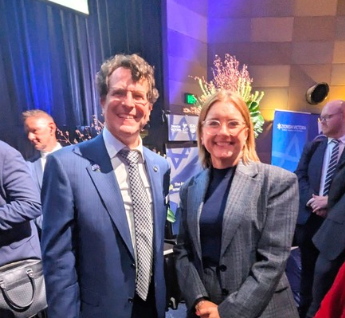


ECAJ President Anton Block was honoured last night with officially launching the results of the Gen17 Australian Jewish Community Survey.
Anton thanked Professor Andrew Markus and Dr David Graham for their outstanding and thorough work on the survey, which garnered over 8,000 responses – the highest of any study of any Jewish community ever carried out anywhere in the world.
In his speech, published by J‑Wire below, Anton highlighted the importance of these results for the Australian Jewish community, which will be crucial for future planning, funding, and organisational continuity.

Gen17 launched
March 28, 2018
J‑Wire Newsdesk
The Gen17 Australian Jewish Community Survey has been launched in Melbourne following last week’s Sydney event.
8,621 members of the Australian Jewish community filled out the survey between February and May in 2017.
The president of The Executive Council of Australian Jewry Anton Block said: “This is not just a survey of mathematical statistics – as portrayed in my little story – but an insight into our community. It tells a story of who we are as a community in 2017.
Few would disagree that we are a fortunate community. We live in one of the greatest countries in the world and have the opportunity to live life freely as Jews. Our forebears built our community and our community structures on solid foundations. The number, range and vibrancy, of Jewish communal organisations attests to this.
But of course, who we are as a community continues to change and evolve. Our evolution is influenced by many factors including migration, prosperity, aging, distance in time from the Holocaust, distance in time from the establishment of the State of Israel, levels of education and general societal influencers.
The Gen17 Report has produced a rich data set from which we can derive a fascinating snapshot of Jewish communal attitudes in 2017.
The survey is impressive both because of the number of respondents – the highest of any study of any Jewish community ever carried out anywhere in the world – and because of its methodological rigour. A thorough consultation of the Jewish community ensured that the survey questions were formulated so as to reflect our major concerns as a Jewish community on matters as diverse- as Jewish identity, intermarriage, Jewish education, communal life, socioeconomic wellbeing, charitable giving, migration, Israel and Antisemitism. Census data and other objective records were studied and used as a baseline to ensure that the Gen 17 survey results were appropriately weighted to exclude any skewing of the data towards any demographic or other group in the community, and to ensure the representativeness of the responses.
The survey results are relevant to every organisation in our community because the topics are embedded in the raison d’tre for those various Jewish organisations.
Given that the Gen17 survey follows on from the Gen08 report, we are now able, with certain qualifications, to look at trends in attitudes and perhaps more importantly, community needs as they have evolved from 2008 and into the future. This provides us with an invaluable tool to assist community planning and the dedication of community resources.
As stated in the Foreword of the Report written by JCA President, Stephen Chipkin, “To realise our aspirations and plan more effectively even to dream more fully – we must understand who we are in the here and now. What drives our community today? Who are we as Jews? What are communal needs? How do we give back? What matters to us? How do we relate to one another? It is these question, and so many more, that the Gen17 survey has endeavoured to answer.”
It is the desire to continue to have not just the best, but what is actually needed, that drove the Gen17 report and the Gen08 report before it. And this requires planning.
I am reminded of the famous words of Benjamin Franklyn, “If you fail to plan, you are planning to fail!”
My question is, who will be looking at this information and doing the planning?
In NSW the answer is clear, it is the JCA, working together with the Jewish communal roof body in that State, the NSW Jewish Board of Deputies.
Not only does the JCA raise funds on a community basis, it allocates those funds to the organisations and projects in the community which best meet the needs and strategic plan of the community. No doubt this is why the JCA is a major sponsor of the study.
But who will be performing this task in Victoria?
Clearly, Jewish Care will be making significant use of some of the Gen17 data. It is utterly appalling that in a community as wealthy as ours, more than one Jew in 20 (6%) suffers from severe financial hardship to the point where they have had to cut back on food or go without prescription medicine because of a lack of financial means. Material deprivation of such depth cries out for a communal program. The Torah is explicit. If any of our fellow Jews become poor and are unable to support themselves, we are obligated to help them: Vayikra 25:35.
Welfare, however, is only one part of the communal picture. Who will do the planning for youth engagement, Jewish education, communal security, combatting antisemitism and supporting Israel? And who will have the oversight as to the allocation of limited communal resources between each of these critical sectors? The last real attempt at communal planning in Melbourne was in 1994. It took the form of the Commission for the Future Report which was commissioned by the JCCV.
The brief was to enquire into and report to the JCCV as to whether the current range of services, facilities and fundraising practices offered or conducted by the Victorian Jewish communal organisation for Victorian communal purposes were the most effective to meet the needs of the community as it approaches and prepares for the next century, having regard not only to objective criteria but also to the community’s needs and sensitivities.
The conclusions were:
- The community needs planning: In all areas the Commission found a lack of systematic planning which was affecting the nature of services provided and the cost of providing services. In no sector was there adequate analysis of needs nor sufficient rigorous analysis of service provision. The failure to plan meant some services were absent or inadequately researched as a result of historical factors rather community decision – This was re-affirmed in 2010 as one of the conclusions on a further study done on the merits of creating a Victorian community appeal- namely that without a VJCA there is likely to be a lack of insightful communal strategic planning resources.
- The community needs information. There is a lack of community data which prevents prompt or adequate responses to demographic, economic or social change;
- The community can rationalise allocation of resources. The Commission found a disturbing lack of co-operation between community organisations. If this is overcome, it will offer great potential to improve the community’s financial position by rationalising the use of both material and human resources;
- The community needs leadership. Leaders of community organisations are consistently presented as advocates for particular causes rather than leaders of the community.
Regrettably, the only real outcomes were the merger of the Montefiore Homes and Jewish Community Services (as it then was) and the disbanding of the Commission. Why? Because the community failed to “buy in” to do what needed to be done.
The Gen17 survey results indicate that the Melbourne Jewish community is marginally more religiously observant and Zionistic than the Sydney Jewish community. Some attribute this difference to the organisational structure in Victoria, as compared to NSW. I don’t agree. I would attribute this difference, small as it is, to the much higher proportion of Jews in Melbourne whose families originated in the tight-knit Jewish communities of Eastern Europe.
Interestingly, the report also indicates that 58% of the Melbourne Jewish community are open to having one central fundraising organisation (30% of that number would even prefer a central structure) even though Melbourne Jewry has not experienced such a model. This compares to 80% in Sydney which actually has such a fundraising model.
Centralised fundraising would provide the Victorian community with the ability to direct funds to those projects which respond to the information provided by the Gen17 report. Past experience confirms that the causes which the objective evidence tells us the community most needs to support are not always the causes that meet the subjective passions and priorities of individual donors.
But perhaps more importantly, a consistent system of fundraising and planning in both NSW and Victoria would greatly facilitate the development of coherent planning for our community on a nationwide basis on such critical matters as communal security, youth engagement and Jewish education. Australia ceased to be a collection of distinct colonies in 1901, but the Jewish communities in Melbourne and Sydney still operate to a large extent as though Federation never happened.
We cannot continue to ignore the central message of Benjamin Franklin’s words. The time has come at both a Victorian and National level to engage in meaningful community planning to assist in the shaping of communal agendas, catalysing the creation of new initiatives and realigning priorities.
The Gen17 report gives us the empirical basis for engaging in this necessary work.
On behalf of the Australian Jewish Community, I commend and thank Professor Andrew Markus and Dr David Graham for their outstanding work and I look forward to working with our community leadership and donors in implementing strategic planning now and into the future.”