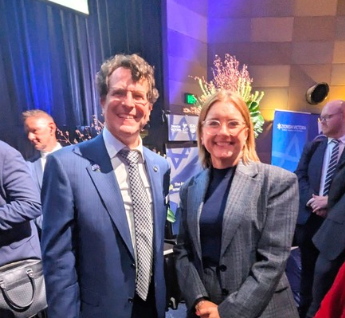


The following article has been published in The Australian by ECAJ co-CEO Alex Ryvchin.
The White House has announced that Israel and the United Arab Emirates have agreed to sign a peace agreement which will see the two nations establish full diplomatic relations, and “the exchange of ambassadors and cooperation on a broad range of areas, including tourism, education, healthcare, trade, and security.” The agreement is the most significant diplomatic development in the Middle East since Israel signed a peace treaty with Jordan in 1994 and it formalises a major regional realignment that has been occurring clandestinely for decades.
It is difficult to overstate the historic nature of the agreement and its implications for the politics of the region. Since Israel declared independence in 1948 pursuant to the United Nations General Assembly partition plan to turn Palestine from a former Ottoman colonial possession into two new nation-states, one Arab and one Jewish, a permanent state of war has existed between Israel and its Arab neighbours. This has manifested in invasions of Israel in 1948, 1967 and 1973 by the combined armies of the Arab states on Israel’s borders, and endless skirmishes in the United Nations and international forums often to the discredit of those institutions and at the expense of far more pressing human rights and conflict issues.
This modus vivendi arose from an absolute rejection by the Arab world of Jewish claims to self-determination in any part of the land to which the Jews traced their origins and with which they maintained an unbroken physical connection for over 3,000 years. The permanent state of war was formalised in an emergency session of the Arab League held in Khartoum, Sudan in the wake of Israel’s lightning victory in the 1967 (Six Day) War, at which the member states agreed to what came to be known as the “three no’s” – no peace with Israel, no recognition of Israel and no negotiations with Israel.
The United Nations offered a different path. Security Council Resolution 242 called for the cessation of war and conflict in the region through a mechanism known as “land for peace” by which the defeated Arab states would make peace with Israel in exchange for Israel’s withdrawal from part or all of the territories Israel’s occupied in the 1967 War. This formula was successfully applied to reach landmark agreements with Egypt in 1979 and with Jordan in 1994.
Though Resolution 242 was intended to govern the relationship between sovereign states in the region and did not contemplate an Israeli agreement with the stateless Palestinians, the underlying principles of 242 – mutual recognition, territorial concessions and an end to war, were applied by the Palestinians and Israel in 1993. This resulted in the signing of the Oslo Accords which led to multifaceted cooperation and the pursuit of a final status agreement to end the conflict.
But even while appearing to pursue its own bargain with Israel, the Palestinians demanded Arab solidarity against Israel through a strict doctrine of anti-normalisation – that is, Israel was to be treated as a pariah, an unwanted, temporary interloper in the region of Islam and Arab nationalism, until it capitulated to Palestinian demands, including the settlement of up to seven million Palestinians in Israel, whose land area is roughly equivalent to Tasmania’s.
But while Arab leaders mouthed platitudes about solidarity against the Jewish State, the cartel of rejectionism and anti-normalisation was gradually being broken not only by the major peace agreements but by small, though highly potent gestures that evidenced a major awakening.
In March 2018, Israeli passenger planes were permitted to fly over Saudi airspace for the first time. In October of that year, Israeli Prime Minister Netanyahu made a visit to the Omani capital, Muscat while his sports minister flew to Abu Dhabi where Israel’s judo team was permitted to compete in a major tournament, breaking a longstanding sports embargo that frequently saw athletes from Islamic countries withdraw from events when drawn against Israeli opponents. Netanyahu’s meeting with the Sudanese leader earlier this year was particularly rich with symbolism given it was in the Sudanese capital that the anti-normalisation policy had been adopted.
The process by which Arab nations have come to find peace with a sworn enemy is a remarkable one – a mix of power politics and pragmatism. For the Gulf States, Iran has long been the chief adversary, spawning tit-for-tat strikes and reprisals and enormous bloodletting through proxy wars in Yemen and Syria. The Sunni States were spooked by the Obama Administration’s signing of the nuclear deal with Iran which resulted in a $150 billion sanctions relief windfall for the regime allowing it to salvage its economy, expand its weapons testing programs and deepen sponsorship of Hezbollah, the Assad regime and the Houthis.
For the Gulf States, seeing US and European leaders literally throwing their arms around the grinning Iranian foreign minister rather than exerting maximum pressure on the regime, or better still, facilitating its collapse, left them feeling utterly exposed. They observed that the world leader most outspoken and fearless in opposing the Iran Deal, and the only one who seemed to truly share their understanding of the brutal malevolence of the Iranian Mullahs, was the Israeli prime minister.
Israel’s rapid transformation from a largely agrarian economy built on socialist ideals to super-charged capitalism from which new technology in medicine, cybersecurity and water management pours forth like the waters of the Jordan, made the Jewish State far harder to ignore, much less boycott. This has meant that world leaders now visit Israel less to hector on behalf of the Palestinians and more to sign agreements to transform their own economies and improve the lives of their citizens.
The self-defeating and baffling Palestinian approach of rejecting three offers of statehood since 2000 and now refusing to even negotiate to end the conflict with Israel has turned wider Arab fatigue with the Palestinian issue into exasperation bordering on total apathy. The perpetual talk of the “Arab street” being alight with pro-Palestinian feeling has been proven hollow enabling Arab leaders to make peace with Israel with no downside.
The decision of the UAE to find peace with Israel will conceivably pave the way for similar treaties with Bahrain, Oman, Kuwait and Saudi Arabia, further isolating the Iranian axis. It will also increase Israel’s regional integration and the fulfilment of the vision contained in its Declaration of Independence of achieving “peace and good neighbourliness” with the peoples of the region. This peace treaty has also revealed the realities of Middle East policymaking, vindicating the Israeli Prime Minister in his long-held belief that peace comes through strength and economic utility and not simply by pleading with one’s adversaries for acceptance.
Alex Ryvchin is Co-Chief Executive Officer of the Executive Council of Australian Jewry and the author of Zionism – The Concise History.