
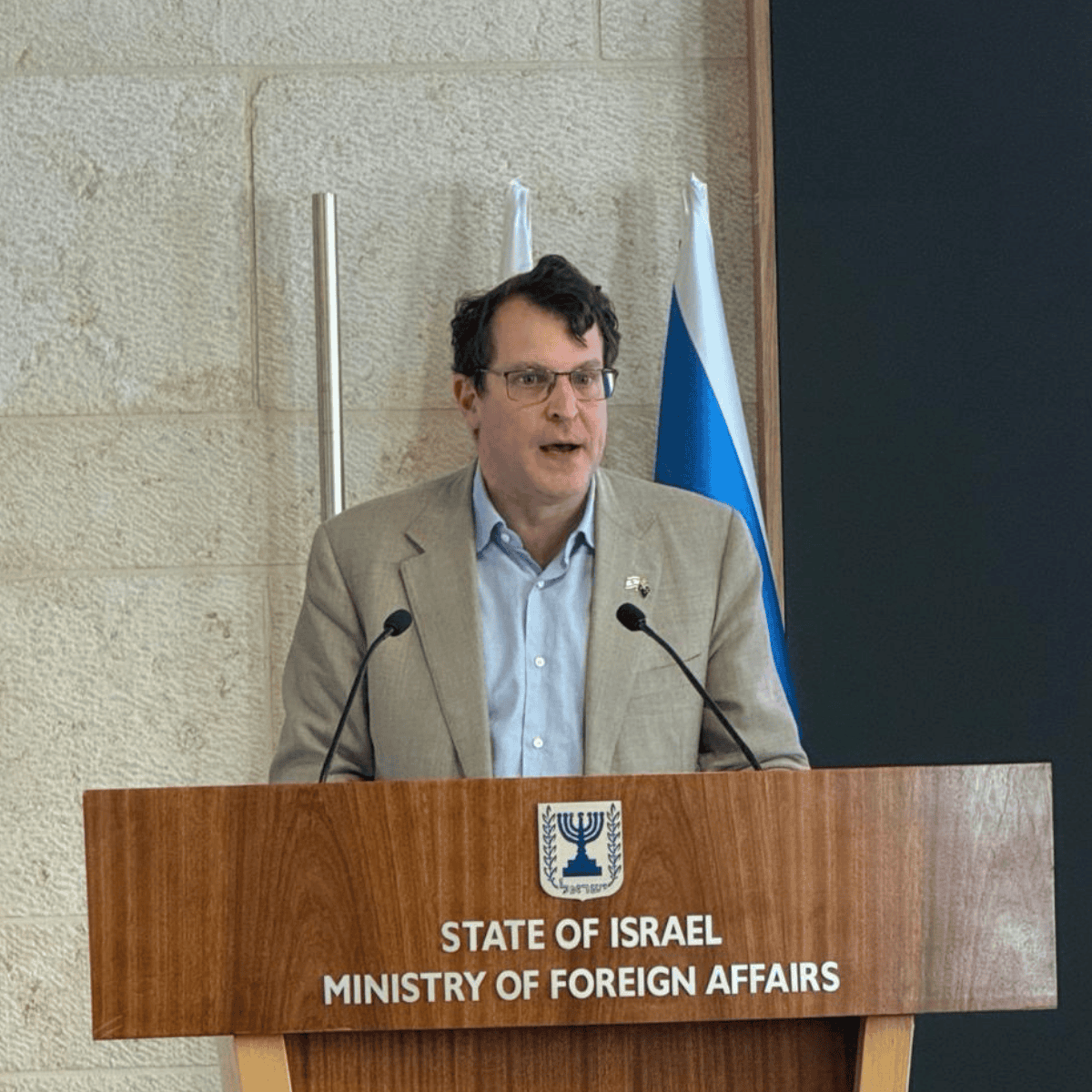
Daniel Aghion’s speech to the J50
The Australian experience of the last year, has been led by the massacre at Bondi Beach in Sydney in December 2025, and the Royal Commission into Antisemitism and Social Cohesion that has been running over the last 8 months.
My purpose is to provide as much guidance to you as I can from our experiences.
Three points:
1. Crisis management.- Raise your hands if your community has a comprehensive written crisis management plan. – Keep your hands up if you have a plan at the national level, and also separate plans for each major city or region where Jews are present in your country.- Keep your hand up if national and regional plans are interconnected.- Finally, keep your hand up if all of those plans, regional and national, are tested every 12 months, by using test runs and training scenarios.
In March 2026, I was at the ADL conference in New York. I stood on stage with the leadership of Diaspora communities who had suffered violent attacks in the previous 12 months. 5 attacks, 20 dead, across 3 countries.
Those were only violent attacks which caused death. It did not include attacks which caused physical injury, significant property damage, or trauma.
Let me say a simple but dark truth. In the next 12 months, there will be violent attacks (plural) on Jews around the world, because they are Jews. In the next 12 months, it is likely someone in the Diaspora will die because
they are Jewish. The only thing we do not know about those attacks in the next 12 months, is
the place and the date.
As the community leadership, you must plan on the basis that your community is the next target. You cannot assume that the attack will happen elsewhere.
That is why up to date, well practised, crisis management plans are so important. Those who had their hands up at the end, raise them again please. For everyone else, look around at those who have their hands raised. Find a
country that is similar to yours. Not necessarily similar size of Jewish community. But similar community structure.
Similar organisations. Similar communal thinking. Start a conversation with them. Ask how they developed
their crisis management plan. How do they test it? Do they have experts who can assist you? But I stress that the plan must be developed for your country. If it is simply copied from another country, without considering your
own structure, your organisations, your government and police relations, it will fail.
2. Long term trauma
One thing we did not expect, was the long term impact of an attack like Bondi.
15 died, of which 12 were Jewish. 42 injured, requiring hospital treatment.
About 3 – 400 people at Hannukah by the Sea event
About 45,000 Jews living in Sydney, and about 120,000 in Australia. Everyone in the community knows someone who was affected.
And then, there are the non-Jews. I have met a South Korean family. They are Christian and pro-Israel. They heard of this Jewish event called Hannukah. They knew nothing about it, but they heard there would be a
petting zoo, face painting, singing and dancing by the beach. It sounded like a fun, family event. So they went – husband, wife, two teenage children. The wife was shot. She survived, but has permanent damage to one of her eyes. The husband is a truck driver but is not working because he has flashbacks.
And the children? The father said to me “they are very quiet. There is no talk in the house any more, no laughter, we all sleep late and we have no energy.”
I sincerely hope that there will not be an attack anywhere in the Diaspora, but that is not realistic. If there is an attack in your country, you have to expect that there will be long term impacts. The Sydney Jewish community
and the Australian Jewish community will recover. But it will take a very long time.
3. Royal Commission into antisemitism and social cohesion
A Royal Commission is the highest level of official enquiry that can be held in Australia.
After pressure from both the Jewish and non-Jewish community after Bondi, the Government announced the Royal Commission. It is a formal process conducted before a retired judge, who receives written submissions and oral evidence. 20,000 written submissions were made, the most that any Australian RC has ever received. The Commissioner has heard oral evidence from nearly 350 witnesses.
I am happy to be corrected on this statement, but to my knowledge it is the only official Government enquiry into antisemitism in the world in recent times.
It has been a massive exercise over the last year. The Jewish community has spent millions of dollars, and many millions more in pro bono legal and non-legal work. This was to make sure that our voice is heard properly, both
inside and outside the Commission, and to ensure that the Commission has run as well as it can.
The question is what the Diaspora can gain from our efforts. I do not recommend that you ask your government for your own official enquiry or commission. As I say, it is an enormous amount of work. And we had the tragedy of Bondi as the impetus to compel our government to act.
The Commissioner will deliver her final report on 18 December, 4 days after the anniversary of Bondi. The report will contain a narrative, and also recommendations.
The importance for the Diaspora, is that you may be able to take some of the recommendations that the Commissioner will make, adapt them to your local law or culture, and then press your governments and non-government institutions to adopt them.
It will be a very large document. I invite you to at least look at the recommendations. If the narrative section is too long, perhaps run it through AI to get a summary that applies to your country. We will try to help you by preparing and distributing a general summary.
One thing we have learned is that stronger anti-hate laws are not enough.
Combatting antisemitism requires cultural change as well. In all sectors of society: business, politics, policing, arts and creative industries, sport, and many more.
For us therefore, the Royal Commission report is only the first stage, the second stage is implementation, and the third stage is continued monitoring of that implementation.
The positive message is that non-Jewish Australians were shocked by Bondi, and have started to understand the need for change. Australian Jews are now being treated better, and there is a greater sense of compassion and understanding. Pure antisemites are being pushed to the edges of Australian society, and the general community is much less forgiving of the pro-Palestinian movement and its slogans. Australians have woken up and we are already seeing significant changes, even before the Commission has delivered its final report.
ECAJ president Daniel Aghion delivered this speech to the J50 – leaders of 50 major Jewish Diaspora communities, hosted by Israel’s Ministry of Foreign Affairs – in Jerusalem on Tuesday

Characterising Zionism As A ‘Political Ideology’
Reflecting on recent court cases, ECAJ co-CEO Peter Wertheim says the characterisation of Zionism as a political ideology lacks rigour.